Sinopsis
Foreign policy podcasts hosted by Mark Leonard, Director of the European Council on Foreign Relations (ECFR), the first pan-European think-tank.
Episodios
-
![The Leopards are free!]()
The Leopards are free!
27/01/2023 Duración: 29minOn 25 January, after months of deliberation, Germany's chancellor Olaf Scholz announced he would send Leopard 2 tanks to Ukraine – and permit other countries to do the same. What led to this turnaround? Mark Leonard is joined by ECFR heavyweights on security and defence policy – Camille Grand, Gustav Gressel, Jana Puglierin, and Jeremy Shapiro – to discuss what this decision means for the war in Ukraine, for German diplomacy, and for transatlantic relations. Will the unity on show at last week's Ramstein meeting continue in the long term? And what is the future of military aid for Ukraine? This podcast was recorded on 25 January 2023. Further reading - The Leopard plan: How European tanks can help Ukraine take back its territory by Gustav Gressel, Rafael Loss and Jana Puglierin: https://t.co/2798lmtF1x - Send in the Leopards: Why Western allies should deliver tanks to Ukraine by Margaryta Khvostova & Dmytro Kryvosheiev: https://t.co/BV7Hs0TvYx Bookshelf:- Les Ambitions Inavouées by Thomas Gomart- Putin'
-
![Davos world: Alexander Stubb and Mark Leonard live from the WEF]()
Davos world: Alexander Stubb and Mark Leonard live from the WEF
20/01/2023 Duración: 22minThis week’s episode comes to you all the way from the snowy peaks of Davos, Switzerland. Mark Leonard is joined by ECFR board member Alexander Stubb – who is director of the school of transnational governance at the European University Institute in Florence and a former prime minister of Finland – to give us their take on this year's World Economic Forum. What does cooperation in a fragmented world look like? Does the war in Ukraine still top the bill in every WEF session, and how do leaders discuss the energy crisis? Leonard and Stubb share their thoughts on all this and more, including the US Inflation Reduction Act, India’s role in the multipolar world, and Olaf Scholz’s speech. This podcast was recorded on 18 January 2023. Bookshelf:• Personality and Power: Builders and Destroyers of Modern Europe by Ian Kershaw• Leadership: Six Studies in World Strategy by Henry Kissinger Hosted on Acast. See acast.com/privacy for more information.
-
![Catherine Ashton on 21st century diplomacy]()
Catherine Ashton on 21st century diplomacy
13/01/2023 Duración: 35minIn this episode, Mark Leonard welcomes Catherine Ashton – the European Union’s first high representative for foreign affairs and security policy and the first female EU commissioner for trade – to talk about her new book “And Then What? Inside Stories of 21st Century Diplomacy”. As a seasoned mediator, Ashton played a crucial role in negotiating the ‘Brussels agreement’ between Serbia and Kosovo in 2013 and the Joint Plan of Action with Iran the same year. But what is her outlook on diplomacy today? How can diplomats lay the groundwork for success? Concerning Ukraine, what are the chances for diplomacy under such difficult global conditions? And what role should the United Kingdom play in future European and international relations? This podcast was recorded on 1o January 2023.Bookshelf:- And Then What? Inside Stories of 21st Century Diplomacy by Catherine Ashton - Never by Ken Follett - Leadership: Lessons from a Life in Diplomacy by Simon McDonald Hosted on Acast. See acast.com/privacy for more information
-
![Top ten foreign policy trends for 2023]()
Top ten foreign policy trends for 2023
06/01/2023 Duración: 22minOur beloved predictions episode is back! As they do every year, Mark Leonard and ECFR research director Jeremy Shapiro forecast the foreign policy trends and events for the year ahead.If other analysts saw it coming, Mark and Jeremy certainly didn’t. Their 2022 prediction of “no large-scale Russian invasion of Ukraine” really threw last year’s scoring off leaving them with only 6/10 points. Will they do better this time? And what are your foreign policy predictions for 2023? Send us an email or tweet them to us using #Worldin30Minutes! This podcast was recorded on 4 January 2023.Further reading:2023: The year we learn to stop worrying by Mark Leonard & Jeremy ShapiroBookshelf:•Vladimir by Julia May Jonas•Anéantir by Michel Houellebecq•Exhalation by Ted Chiang Hosted on Acast. See acast.com/privacy for more information.
-
![A battle on two fronts: Poland, Germany, and the rule of law]()
A battle on two fronts: Poland, Germany, and the rule of law
21/12/2022 Duración: 28minAfter the EU finally came to an agreement with Hungary over financial aid for Ukraine, all eyes are now on Poland and its own protracted conflict with Brussels over its rule-of-law inadequacies. Meanwhile, a series of public spats between Warsaw and Berlin has drawn attention to the rifts within the EU and a new East-West divide. In this week’s episode, Mark Leonard is joined by Piotr Buras and Jana Puglierin, heads of ECFR’s Warsaw and Berlin offices respectively and senior policy fellows. Together they talk about Poland’s standing within the EU and Polish-German relations. What is the state of the rule of law in Poland? How has the war in Ukraine affected Polish politics and Poland’s relationship to its neighbours and the EU? And finally, why does Poland have it out for Germany? This podcast was recorded on 16 December 2022. Further reading - “The final countdown: The EU, Poland, and the rule of law” by Piotr Buras: https://buff.ly/3WjF7k6 Bookshelf - “Spat Over Patriot Missiles Reveals Deepening Rifts in
-
![Introducing: In:Sight China with Wang Jisi]()
Introducing: In:Sight China with Wang Jisi
16/12/2022 Duración: 26minNew mini-series! Subscribe here: https://soundcloud.com/ecfrclips China is becoming ever more important to global affairs. But the covid-19 pandemic, as well as political and geopolitical challenges, mean that Europeans’ ability to engage with Chinese thinkers and understand their views and ideas about the world has diminished. In this mini-series, Mark Leonard and Janka Oertel will try to change that by engaging in conversations with some of the best Chinese academics, researchers, writers, and journalists on diverse topics in Chinese internal debates that matter most to Europeans.In the first episode, the hosts are joined by Wang Jisi, the founding president of the Institute of International and Strategic Studies at Peking University and one of the world’s most prominent scholars on US-China relations. Together, we will learn about China’s understanding of global order and the recent developments in the geopolitical landscape with a focus on US-China. What can we take away from China’s stance at the G20 sum
-
![Backsliding democracy: Zsuzsanna Szelenyi on Hungary]()
Backsliding democracy: Zsuzsanna Szelenyi on Hungary
09/12/2022 Duración: 32minThe European Council is considering freezing €7.5 billion in funds allocated to Hungary due to concerns about rule of law violations. Meanwhile, prime minister Viktor Orban has embarked on a controversial “national consultation” concerning EU sanctions against Russia, increasingly isolating Hungary among member states. In this week’s podcast, Mark Leonard is joined by Zsuzsanna Szelenyi, a Hungarian politician and foreign policy specialist, to discuss the situation in the country. What would the freezing of EU-funds mean for Hungary-EU relations and Hungary’s role in the union? What new alliances is Orban trying to foster among other illiberal governments in Europe? And finally, how could Hungary’s confrontational approach to Brussels shape European foreign policy when it comes to Russia, and even China?This podcast was recorded on 7 December 2022.Bookshelf:• “Tainted Democracy: Victor Orbán and the Subversion of Hungary” by Zsuzsanna Szelényi• “Mind the gaps: The pending suspension of Hungary’s EU funds” by
-
![Rethinking the purpose of AI with Stuart Russell]()
Rethinking the purpose of AI with Stuart Russell
02/12/2022 Duración: 32minFrom search engines to social media, from navigation systems to medical gear, our everyday lives are already intertwined with artificial intelligence. But as AI becomes ever more powerful, questions around security risks, ethical use and disinformation arise. In this week’s episode, Mark Leonard is joined by Stuart Russell, professor of electrical engineering and computer sciences and holder of the Smith-Zadeh Chair in Engineering at the University of California at Berkeley. They discuss artificial intelligence’s capabilities to solve global problems and humans’ ability to control its dark side. What benefits can AI bring to health and education? How do algorithms foster extremism and the polarisation of public debates? And finally, could lethal autonomous weapons be ethically used? This podcast was recorded on 3 November 2022. Bookshelf: -“Superintelligence: Paths, Dangers, Strategies” by Nick Bostrom - “Life 3.0: Being Human in the Age of Artificial Intelligence” by Max Tegmark - “The Precipice: Existenti
-
![The global race for semiconductor hegemony]()
The global race for semiconductor hegemony
25/11/2022 Duración: 39minThe semiconductor industry has become the cornerstone of the structure of the global economy and the balance of geopolitical power. And Europe has now joined the United States and China in a ‘chip war’ for global semiconductor domination.In this week’s episode, Janka Oertel, head of ECFR´s Asia programme and senior policy fellow, is joined by Chris Miller, assistant professor of international history at Tufts University, and Andrew Small, senior transatlantic fellow at the German Marshall Fund and ECFR alumnus. They discuss how chips decide power in today’s geopolitical competition. What role does Taiwan’s leadership in semiconductor production play in tensions with China? And to what extent will Europe align and integrate with the United States’ China policy in the upcoming years?This podcast was recorded on 16 November 2022.Bookshelf:•“Chip War: The Fight for the World's Most Critical Technology” by Chris Miller• “The Rupture: China and the Global Race for the Future” by Andrew Small - One of the FT Best Bo
-
![The Clash of Orders with Comfort Ero on Nigeria]()
The Clash of Orders with Comfort Ero on Nigeria
18/11/2022 Duración: 32minMany Europeans see the war in Ukraine as an attack on the ‘rules-based order’. But to many people in other parts of the world, there is no consensus on a set of rules to govern global affairs – and no sense of order. In this mini-series, Mark Leonard will go on an intellectual tour of the world, talking to key thinkers about how order is being defined by different powers. He explores how the clash between these different notions plays into the big shocks facing the world – from climate change and future pandemics to geopolitical struggles and technological disasters – and what this means for national and global politics.-----In this sixth instalment, Leonard is joined by Comfort Ero – president and CEO of the International Crisis Group – to learn more about the Nigerian perspective on global order. How can oil and gas output help Nigeria position itself advantageously in the context of the war in Ukraine? What role do African regionalism and Pax Africana play in building the continent’s capacity to respond to
-
![15 years of ECFR: Reflections on Europe in a tumultuous world]()
15 years of ECFR: Reflections on Europe in a tumultuous world
11/11/2022 Duración: 30min9 November is a day of low and high points in history – moments of both loss and of joy. Some important examples include the Pogromnacht in 1938 or the fall of the Berlin Wall in 1989, which marked the end of the cold war. But 9 November 2007 was also the day that brought ECFR’s 50 founding members together, united by a sense that the EU member states could combine their values and resources to become a prototype for a global open society.In this special episode, ECFR council member Mabel van Oranje hosts director Mark Leonard, as well as ECFR founding members Timothy Garton Ash, professor of European studies at the University of Oxford, and Ivan Krastev, chair of the board at the Centre for Liberal Strategies in Sofia. They explore how the momentous historical events of 9 November can help Europeans make sense of the current moment of disorder. Is a reversal happening of the world order brought about by 9 November 1989? What has ECFR’s role been in helping Europe find a strong, united voice and what will it
-
![The Clash of Orders with Vali Nasr on Iran]()
The Clash of Orders with Vali Nasr on Iran
04/11/2022 Duración: 39minMany Europeans see the war in Ukraine as an attack on the ‘rules-based order’. But to many people in other parts of the world, there is no consensus on a set of rules to govern global affairs – and no sense of order. In this mini-series, Mark Leonard will go on an intellectual tour of the world, talking to key thinkers about how order is being defined by different powers. He explores how the clash between these different notions plays into the big shocks facing the world – from climate change and future pandemics to geopolitical struggles and technological disasters – and what this means for national and global politics.---In this fifth episode, Leonard is joined by Vali Nasr – Majid Khadduri professor of International Affairs and Middle East Studies at the Johns Hopkins -SAIS, and a non-resident senior fellow at Atlantic Council’s South Asia Center – to learn more about the Iranian perspective on global order. What role does anti-Americanism play in advancing Iran’s interest in the Middle East? How are notio
-
![The Clash of Orders with Fyodor Lukyanov on Russia]()
The Clash of Orders with Fyodor Lukyanov on Russia
28/10/2022 Duración: 32minMany Europeans see the war in Ukraine as an attack on the ‘rules-based order’. But to many people in other parts of the world, there is no consensus on a set of rules to govern global affairs – and no sense of order. In this mini-series, Mark Leonard will go on an intellectual tour of the world, talking to key thinkers about how order is being defined by different powers. He explores how the clash between these different notions plays into the big shocks facing the world – from climate change and future pandemics to geopolitical struggles and technological disasters – and what this means for national and global politics.---In this fourth instalment, Leonard is joined by Fyodor Lukyanov – chair of the Council on Foreign and Defense Policy and editor-in-chief of the Russia in Global Affairs journal – to learn more about the Russian perspective on global order. Why is the Kremlin so keen on regional integration? How can power guarantee freedom and achieve justice in a rules-based order? And finally, what role do
-
![The Clash of Orders with Pratap Bhanu Mehta on India]()
The Clash of Orders with Pratap Bhanu Mehta on India
21/10/2022 Duración: 34minMany Europeans see the war in Ukraine as an attack on the ‘rules-based order’. But to many people in other parts of the world, there is no consensus on a set of rules to govern global affairs – and no sense of order. In this mini-series, Mark Leonard will go on an intellectual tour of the world, talking to key thinkers about how order is being defined by different powers. He explores how the clash between these different notions plays into the big shocks facing the world – from climate change and future pandemics to geopolitical struggles and technological disasters – and what this means for national and global politics.---In this third episode, Leonard is joined by Pratap Bhanu Mehta – Laurance S Rockefeller visiting professor at Princeton University and former president of the Centre for Policy Research, a New Delhi-based think tank – to discuss the Indian perspective on order. What is the link between civilisational power and Hindu nationalism? Why is the concept of development so important for a just inte
-
![The Clash 0f Orders with Aslı Aydıntaşbaş on Turkey]()
The Clash 0f Orders with Aslı Aydıntaşbaş on Turkey
14/10/2022 Duración: 32minMany Europeans see the war in Ukraine as an attack on the ‘rules-based order’. But to many people in other parts of the world, there is no consensus on a set of rules to govern global affairs – and no sense of order. In this mini-series, Mark Leonard will go on an intellectual tour of the world, talking to key thinkers about how order is being defined by different powers. He explores how the clash between these different notions plays into the big shocks facing the world – from climate change and future pandemics to geopolitical struggles and technological disasters – and what this means for national and global politics.--In this second instalment, Leonard is joined by Aslı Aydıntaşbaş, associate senior policy fellow and in-house Turkey expert at ECFR, to talk about the country’s understanding of order. Does Russia’s control and presence in Turkey's backyard pose a strategic problem? How can the Pax Ottomana push back against a Western-dominated world order? And finally, what role do narratives about the Batt
-
![The Clash of Orders with Rana Mitter on China]()
The Clash of Orders with Rana Mitter on China
07/10/2022 Duración: 39minMany Europeans see the war in Ukraine as an attack on the ‘rules-based order’. But to many people in other parts of the world, there is no consensus on a set of rules to govern global affairs – and no sense of order. In this mini-series, Mark Leonard will go on an intellectual tour of the world talking to key thinkers about how order is being defined by different powers. He explores how the clash between these different notions plays into the big shocks facing the world – from climate change and future pandemics to geopolitical struggles and technological disasters – and what this means for national and global politics.--In this first episode, Leonard is joined by Rana Mitter, vice-president of the British Academy and professor of the history and politics of modern China at the University of Oxford, to talk about the Chinese understanding of order. How are economic inequalities and covid-19 challenging Chinese stability? What is the role of multilateralism in the international system? And finally, how do na
-
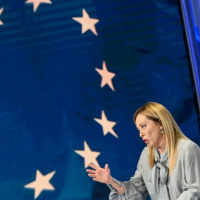
![Giorgia on my mind: The Italian election and European foreign policy]()
Giorgia on my mind: The Italian election and European foreign policy
30/09/2022 Duración: 32minThe success of Giorgia Meloni's Brothers of Italy in the recent Italian general election has sent shudders around Europe. With Meloni set to form a coalition of right-wingers and Eurosceptics, her foreign policy agenda could call into question the very foundations of the European project. Alongside Poland and Hungary, Italy could join calls for greater national sovereignty, aiming to shift the balance of power away from Brussels technocracy. In this week’s episode, Mark Leonard is joined by ECFR council members Nathalie Tocci, who is the director of Italy's Istituto Affari Internazionali, and Marta Dassu, senior advisor for Europe at the Aspen Institute, as well as Arturo Varvelli, head of ECFR´s Rome Office and senior policy fellow. They discuss the implications of the new government in Rome and whether it does indeed point to a shift to the right. What will be the new government's stance be on Russia and its war in Ukraine? And how could constraints such as debt and the coherence of the coalition challenge
-
![Survive and thrive: A European plan to support Ukraine in the long war against Russia]()
Survive and thrive: A European plan to support Ukraine in the long war against Russia
23/09/2022 Duración: 30minVladimir Putin’s announcement of a partial military mobilisation in Russia reinforces the idea that the Ukraine war will not end quickly and that Ukraine and its partners need to prepare for a long war. The Kremlin is sending a clear signal to the West that it will do whatever it takes to succeed—or at least not to fail. For Ukraine to survive and thrive in the long-war, the EU and its member states should formulate a comprehensive mechanism to support their eastern neighbour. In doing so, Europeans can lay the foundations for a functioning Ukraine, deter Russia from further aggression, and perhaps even point the way toward a settlement of the conflict. In this week’s episode, Mark Leonard is joined by ECFR's Piotr Buras, Gustav Gressel, Kadri Liik, and Jeremy Shapiro to describe and debate the potential military, security, and economic aspects of the long-war plan. Why is investment in industrial warfare supply chains so crucial? How can security assurances for Ukraine enhance deterrence and reduce the poten
-
![Rogue NATO: The new face of the Shanghai Cooperation Organisation]()
Rogue NATO: The new face of the Shanghai Cooperation Organisation
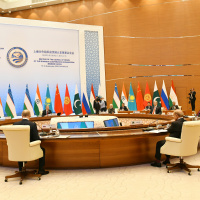
16/09/2022 Duración: 31minThis week's Shanghai Cooperation Organisation (SCO) summit makes tangible the existence of an alternative international community. Featuring leaders from Russia, China, and India it is the organisation's first face-to-face meeting since the Russian invasion of Ukraine. There is a clear goal at the core of the discussions: power politics and the race to multipolarism as an alternative to Western liberalism. In this week’s episode, Jeremy Shapiro joins an all-star ECFR panel of experts to discuss the summit's geopolitical implications. How is SCO “dialogue partner” Turkey using the Ukraine war to get the best of both worlds? How much will Iran's imminent membership advance its security? And finally, what would be the implications for Beijing if Putin were to lose power, and how can China support the Kremlin? This podcast was recorded on 16 September 2022. Further reading:Rogue NATO: The new face of the Shanghai Cooperation Organisation, by Aslı Aydıntaşbaş, Marie Dumoulin, Ellie Geranmayeh & Janka Oertel:
-
![The future of open society with Leonard Benardo]()
The future of open society with Leonard Benardo
09/09/2022 Duración: 36minAs fundamental freedoms are being challenged worldwide, the very idea of open societies is being questioned. The crisis of liberalism and the decline of the West, together with increased disinformation and polarisation, have revealed inequality and the need for critical public debate as a central issue for the advancement of open societies. In this week’s podcast, Leonard Benardo, executive vice president for the Open Society Foundations, joins Mark Leonard to discuss the great challenges open societies are currently experiencing. What role do identity politics play when thinking about solidarity and social cohesion? How can the digital revolution impact electoral democracy? And finally, how can we ensure that Ukraine as an open society is retained? This podcast was recorded on 6 September 2022.Bookshelf:- "Against Decolonisation. Taking African Agency Seriously" by Olúfẹ́mi Táíwò - "Know Your Enemy" podcast hosted by Matthew Sitman and Sam Adler-Bell - Follow @samagreene and @rochowanski for food for thought